
You drop your child off at nursery and they spend the morning building a den out of blankets, digging in the garden, and carefully arranging stones in a line. You pick them up and wonder: were they actually learning anything today? The answer, perhaps surprisingly, is yes. Quite a lot, in fact. Child-led learning is one of the most widely endorsed principles in early years education, and yet it remains one of the most misunderstood by parents who are used to thinking of learning as something that happens at a desk, with a worksheet, led by an adult at the front of a room.
This guide explains what child-led learning actually means, why it works, and what it looks like in practice at a high-quality British nursery in Dubai.

What Does Child-Led Learning Actually Mean?
Child-led learning does not mean that children do whatever they like with no adult involvement. It means that children’s natural curiosity and interests are the starting point for learning, rather than a predetermined curriculum delivered in a fixed sequence.
In practice, this looks like educators observing what individual children are drawn to, what questions they are asking through their play, and what skills they are naturally developing, and then building on those threads with well-chosen materials, environments, and interactions. The child leads the direction; the educator follows, extends, and enriches.
At its core, this approach celebrates the extraordinary potential of the ordinary. A toy car is always a toy car, but a stick, with a touch of imagination, becomes a magic wand, a microphone, or a witch’s broom. By embracing this child-led, play-based methodology, children are recognised as capable beyond measure, becoming the pilots of their own play and the centre of their own development.
Why Child-Led Learning Matters in the Early Years
The early years of a child’s life, from birth to around age five, represent a period of extraordinary brain development. The neural connections being formed during this period lay the foundations for language, emotional regulation, problem-solving, creativity, and social skills. Research in early childhood neuroscience consistently shows that these connections are strengthened most effectively through active, hands-on, self-directed experience rather than passive, adult-directed instruction.
The Curiosity Approach encourages children to explore, investigate, and problem-solve independently. Research in early childhood neuroscience shows that repeated hands-on experiences strengthen neural connections linked to memory, attention, and executive functioning.
When a child is deeply engaged in something they have chosen themselves, their attention is sustained, their motivation is genuine, and their learning goes deeper. This is quite different from the kind of surface-level engagement that happens when a child is simply going through the motions of an adult-set task.
The Role of the Educator in Child-Led Learning
One of the most common misconceptions about child-led learning is that it requires less skill from the educator. The opposite is true. Observing children carefully, identifying the learning that is happening within play, and knowing precisely when and how to extend it without disrupting it requires significant professional expertise and attentiveness.
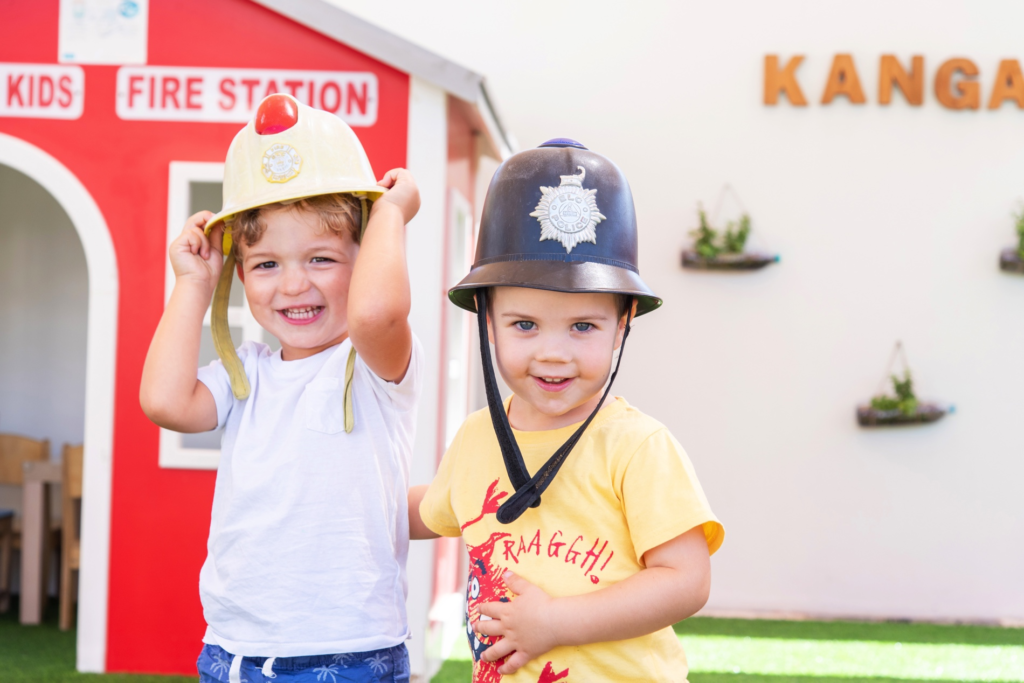
Educators at Yellow Kite Nursery (formerly Kangaroo Kids) create activities based on the children’s current interests, using in-the-moment planning to craft meaningful invitations to play and learn. This approach means the curriculum is genuinely responsive to each child, rather than fixed regardless of where individual children are in their development.
Learning is observed through play, interaction, and engagement. Educators document progress by watching how children explore, communicate, and apply new understanding over time. This kind of observation-based assessment gives a far richer picture of a child’s development than a test or a worksheet ever could.
Does Child-Led Learning Support School Readiness?
This is the question parents ask most often, and it is a fair one. If children are spending their nursery years playing freely, will they be ready for the more structured demands of primary school?
The evidence strongly supports the view that child-led, play-based early years education builds a more solid foundation for school readiness than early formal instruction. Play develops skills such as attention, self-regulation, cooperation, and communication, which are key indicators of later success in school environments.
Child-led learning builds strong foundations for later academic learning by developing concentration, language, problem-solving, and curiosity, which are essential for future literacy and numeracy. A child who has spent their early years developing genuine curiosity, the ability to focus, the confidence to try things independently, and the resilience to keep going when something is hard is far better prepared for formal schooling than one who has been drilled in letters and numbers before they are developmentally ready.
There is no evidence that play delays development. In fact, rushing formal learning can increase stress and reduce motivation in young children.
What Child-Led Learning Looks Like on a Typical Day
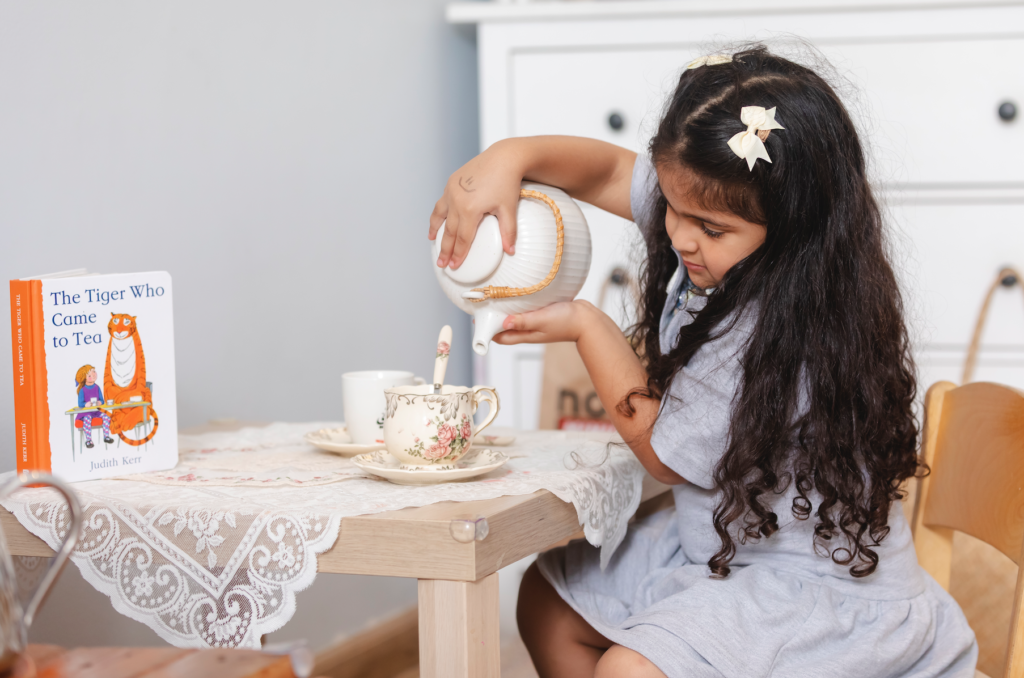
At a good British nursery in Dubai that applies child-led principles, the environment itself is designed to invite exploration. You might see open shelving with accessible natural materials, Curiosity Corners filled with interesting objects to handle and examine, outdoor spaces where children can dig, build, and observe living things, and cosy reading nooks alongside open creative areas.
Each of Yellow Kite Nursery’s (formerly Kangaroo Kids) classrooms features Curiosity Corners filled with awe-inspiring trinkets, mark-making stations brimming with art materials, and cosy nooks perfect for a cuddle and a good book amidst the daily excitement.
A child might spend an extended period building a structure with loose parts, then move to the garden to look for minibeasts, then settle in the book corner with a friend. Throughout all of this, the educator is present, attentive, and ready to engage when the child invites it, asking open questions, introducing new vocabulary, and noting what is emerging in the child’s development without interrupting the flow of their play.
The Importance of Nature in Child-Led Learning
Nature is a particularly powerful context for child-led learning because it is endlessly varied, unpredictable, and rich in sensory experience. Children who spend time in natural environments develop stronger powers of observation, greater physical confidence, and a deeper sense of connection to the world around them.
Yellow Kite Nursery embraces controlled risk, encourages tree climbing, and thrives on fun and creativity. Nature permeates every aspect of the nursery, with children inspired through bug hunts, cloud spotting, gardening, and interactions with the nursery’s unique pets, including Lucky the Giant African Spurred Tortoise and Giant African Snails.
The nursery also embraces the Forest School approach, fostering a deep appreciation for the natural world through immersive play and exploration, and benefits from an expansive 25,000-square-foot garden that offers endless opportunities for outdoor adventures and bold discovery.
Child-Led Learning and Emotional Development
Child-led learning is not only about cognitive development. It has a profound impact on emotional wellbeing too. When children are given genuine agency over their learning, they develop confidence in their own abilities, trust in their environment, and the resilience to navigate difficulty without becoming overwhelmed.
Children are given time and space to explore without constant interruption. This supports emotional regulation, confidence, and resilience, as children learn to trust their instincts and feel secure in their environment.
In the context of a British nursery in Dubai serving a highly diverse international community, this emotional grounding is particularly valuable. Many children are navigating multiple languages, cultural transitions, and new social environments simultaneously. A setting that prioritises their sense of security, agency, and belonging gives them a genuinely strong foundation for all that follows.
How Our Nursery Applies These Principles
Yellow Kite Nursery is the UAE’s only Curiosity Approach Accredited nursery, combining this innovative method with the British EYFS curriculum to inspire children to resiliently lead their own learning journeys and embrace life in their unique way.
The Curiosity Approach draws on the wisdom of early years pioneers including Maria Montessori, Reggio Emilia, Rudolf Steiner, and Emmi Pikler, emphasising a shift away from over-stimulating technology and plastic toys towards the wonders of the natural world and authentic, open-ended resources.
The nursery has been cultivating an environment of positivity and kindness for almost two decades, with passionate teachers who enrich children’s lives through exploration and adventure, sparking curiosity and igniting the imagination. It caters to children from 45 days to five years old and is located in Al Safa 2, Dubai.
A Note for Parents Who Are Uncertain
It is entirely natural to feel uncertain about child-led learning, particularly if your own education was more traditional and structured. Trusting that your child is learning when they appear to simply be playing requires a shift in perspective, and that shift takes time.
The most helpful thing you can do is visit settings, observe children in action, and speak to practitioners about how they track and support individual development. Ask what a child’s day actually looks like, how the environment is designed to support learning, and how educators know each child is progressing. A setting that can answer those questions confidently and with warmth is one that genuinely understands what it is doing.
To learn more about how Yellow Kite Nursery (formerly Kangaroo Kids) brings child-led learning to life, visit us or book a tour to see the setting for yourself.