
If you’ve ever bought a shiny new toy, watched your child unwrap it with excitement… and then spent the next 20 minutes watching them play with the box it came in, you’re not crazy. You’re not alone. And you are absolutely witnessing something powerful.
That’s not a tantrum. That’s play intelligence at work.
At Yellow Kite Nursery, an EYFS nursery in Dubai, we see this every day. Children are drawn to materials that don’t tell them what to do. They want things they can twist, stack, sort, carry, transform, and turn into literally anything their imagination can dream up. These materials are called loose parts, and they’re the silent heroes of meaningful childhood learning.
So What Exactly Are Loose Parts?
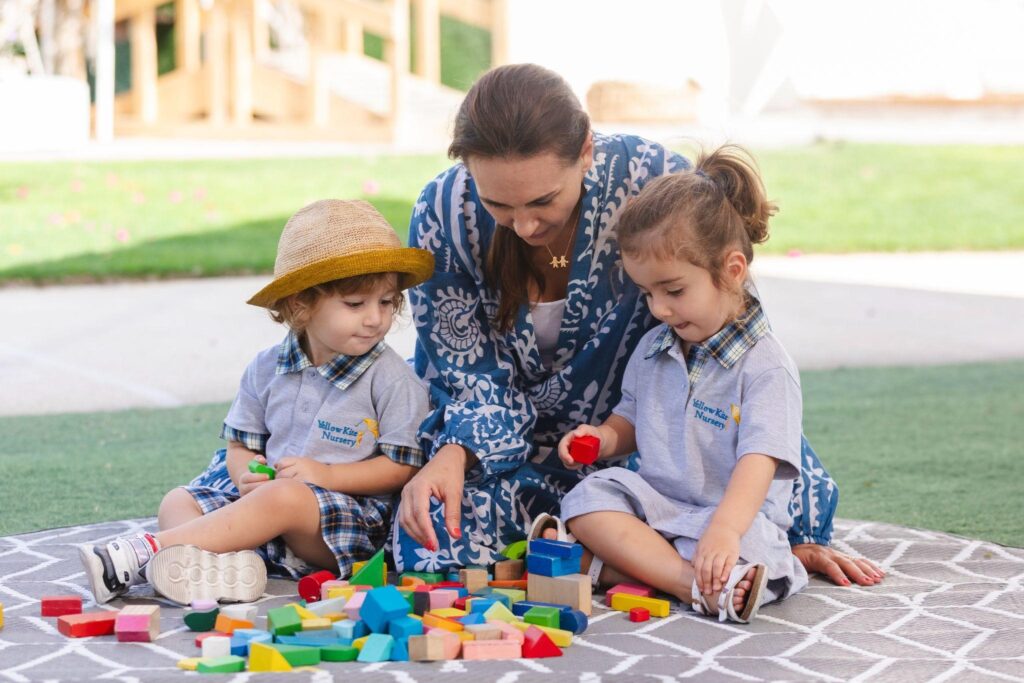
Loose parts are simple objects without a predetermined purpose. They can be combined, moved, rebuilt, lined up, taken apart, and redesigned in countless ways. Think pebbles, shells, ribbons, wooden blocks, cardboard tubes, fabric scraps… even that old bottle cork collection you didn’t know what to do with.
Unlike toys with one “right” way to play, loose parts invite children to decide how they want to interact with the world – not how someone designed a toy to be used. This aligns perfectly with the philosophy of The Curiosity Approach, which emphasises authentic resources, recycled materials, and child-led exploration rather than adult-led instruction.
Here’s how one Curiosity Approach practitioner puts it: loose parts “ensure learning is not prescriptive with adult-determined outcomes. Children take ownership of their play and it opens up endless possibilities for learning and development.”
Why Boxes and Sticks Beat Flashy Toys (Seriously)
Look, plastic gadgets with lights and sounds are fun. But the moment the lights dim or the batteries die, that toy’s appeal can fade fast. Loose parts, on the other hand, have no agenda. Their magic comes from possibility, not programmed outcomes.
That means:
- A cardboard tube can be a telescope, a tunnel for cars, a megaphone, a castle wall, or just a tube.
- A wooden block can be a ramp, a phone, a bridge, or the starting point of a story.
The Curiosity Approach philosophy encourages using authentic, real-world materials – not child-sized plastic toys – because they offer varied textures, weights, and sensations for real exploration.
Children are not here to be entertained. They’re here to think, test, invent, question and discover. If play is the engine, loose parts are the fuel.
What’s Really Happening When Your Child Plays
Loose parts don’t just fill time. They grow brains (yes, literally – more on that in a second). When children interact with loose parts:
They Solve Problems Naturally
You stack pebbles on a stick, and it falls over. Try again. Try a different tactic. Try a new pattern. That’s not frustration — that’s problem-solving practice. Research shows loose parts play encourages creativity, flexibility, and critical thinking.
They Build Communication Skills
Play isn’t silent. Children negotiate roles, explain ideas (“Let’s make this a mountain!”), and use new vocabulary. Ebbs and flows of collaborative play are some of the earliest building blocks of language and social confidence.
They Strengthen Their Bodies
Loose parts play isn’t sitting still. Carrying materials, stacking, balancing, and manipulating them all build gross and fine motor skills, essential groundwork for future tasks like writing, cutting, using tools, and even tying shoelaces.
They Build Emotional Regulation
Perhaps the biggest hidden benefit? Loose parts are non-judgmental. There’s no right way or wrong way. Children experience challenge and solution in a low-stakes way, a crucial foundation for emotional resilience.
Loose Parts Play Is Research-Supported, Not Just Feel-Good
The evidence underscores what educators have known intuitively for years: environments rich in open-ended materials spark deeper cognitive development, creativity, and engagement. The Education Endowment Foundation, a respected UK evidence hub, highlights that play approaches like loose parts support problem-solving, self-regulation, and communication, all predictors of later success.
And across the UK, early years settings using The Curiosity Approach report calm, engaged learning spaces where children “are highly motivated to engage and develop concentration skills and levels of perseverance.”
So What Is The Curiosity Approach Anyway?
The Curiosity Approach is a philosophy grounded in respect for the child’s natural tendency to explore and learn. Rather than traditional colourful plastics and designated “toy stations,” spaces are curated with real, open-ended resources that invite investigation.
It’s about giving children agency – the freedom to choose, decide, and explore – and adults supporting rather than directing play. It’s an explicitly process-focused approach. Learning isn’t about finishing a task; it’s about thinking its way through the task.
And that’s a huge difference from play that looks fun on the outside but is actually predetermined on the inside.
Loose Parts Play in Real Life: What You’ll See
At Yellow Kite Nursery – our EYFS nursery in Dubai – loose parts aren’t an add-on. They’re woven through the day. You might see children:
- Building a marble run with fabric scraps and tubes
- Negotiating roles to carry and sort stones
- Creating “tiny world” scenes with natural objects
- Experimenting with balance and weight as they stack materials
These moments might look quiet, but underneath, children are building agency, confidence, language, and executive function – all while leading the play themselves.
And Yes: You Can Do This at Home Too
You don’t need an expensive kit or a basement playroom. Some of the best loose parts come from your everyday world:
- Stones, pebbles, shells
- Cardboard tubes and boxes
- Fabric scraps and ribbons
- Wooden spoons and bowls
The trick is not to show them how to use it. Let curiosity lead. Make it accessible, but let the child decide the purpose. That’s where the learning happens.
Why This Matters in Today’s World
In busy cities like Dubai, screens, schedules, and structured academic preparation can easily push play to the side. But the science says achievement later depends on the deep foundations built now: emotional regulation, social confidence, curiosity, adaptability, and independent thinking.
Loose parts play supports all of these – without pressure. It honours how children learn, not how adults think they should learn.
Loose Parts Play Isn’t Just Fun. It’s Real Learning
So next time your child ignores the toy and plays with the box – don’t laugh. Applaud. Because what they’re doing is powerful, authentic, and, frankly, exactly what educators would design if we didn’t overthink it.
Loose parts play helps children grow into thinkers, workers, creators, and communicators – not just consumers of prepackaged entertainment.
This is why, at Yellow Kite Nursery, we don’t just sprinkle loose parts play into the day – we build environments where it thrives.
If you’re interested in a nursery where learning respects the whole child – cognitive, emotional, social, and physical – and where play is taken seriously without being pressured – come talk to us. We’re here to support your child’s natural curiosity in ways that feel authentic, joyful, and deeply developmental.