
With the recent changes to the UAE school-age cut-off, many parents are understandably revisiting the idea of school readiness. Conversations have become louder, opinions more divided, and advice more abundant. For families with children approaching the transition to school, it can start to feel as though readiness is something urgent, something measurable, and something that needs to be achieved quickly.
What often gets lost in this noise is a simple but important truth. School readiness is not a checklist. It is not an age. And it is not something that can be accelerated without consequences.
At nursery level, we sit in a unique position. We are not preparing children for school in isolation. We are supporting children who have been developing since birth, each with their own history, temperament, strengths, and needs. Readiness is layered, and those layers matter.
The Pressure to Be “Ready”
Policy changes often come with unintended pressure. When eligibility dates shift, families can feel as though expectations have shifted too. The idea that children now need to be ready earlier can quietly creep in, even when no one explicitly says it.
This is where schoolification can take hold. Early years settings can feel pushed to prioritise visible academic skills sooner, sometimes at the expense of the foundational development that makes those skills meaningful and sustainable.
We want to be very clear. We are not here to fight schools, policies, or transitions. Nurseries and schools exist on the same continuum. Our shared goal is to support children well. Where we hold firm is in our understanding of how children develop, and what truly supports them as they move towards formal learning environments. This is a conversation we hear often from families preparing for the kindergarten in Dubai transition, and it is one we take seriously.
What School Readiness Actually Means
When schools talk about readiness, they are not just talking about reading or writing. They are talking about whether a child can cope emotionally, manage transitions, engage socially, and access learning in a structured environment.
From our experience, where children struggle most when they enter school is rarely academic. It is far more often social and emotional.
Difficulties with emotional regulation, problem-solving with peers, managing frustration, coping with the rigidity of timetables, navigating independence, and even managing basic self-care can all impact how a child experiences school. A child who feels overwhelmed cannot learn effectively, no matter how early they were introduced to academics.
This is why readiness must be understood holistically.
Physical Development Builds the Brain
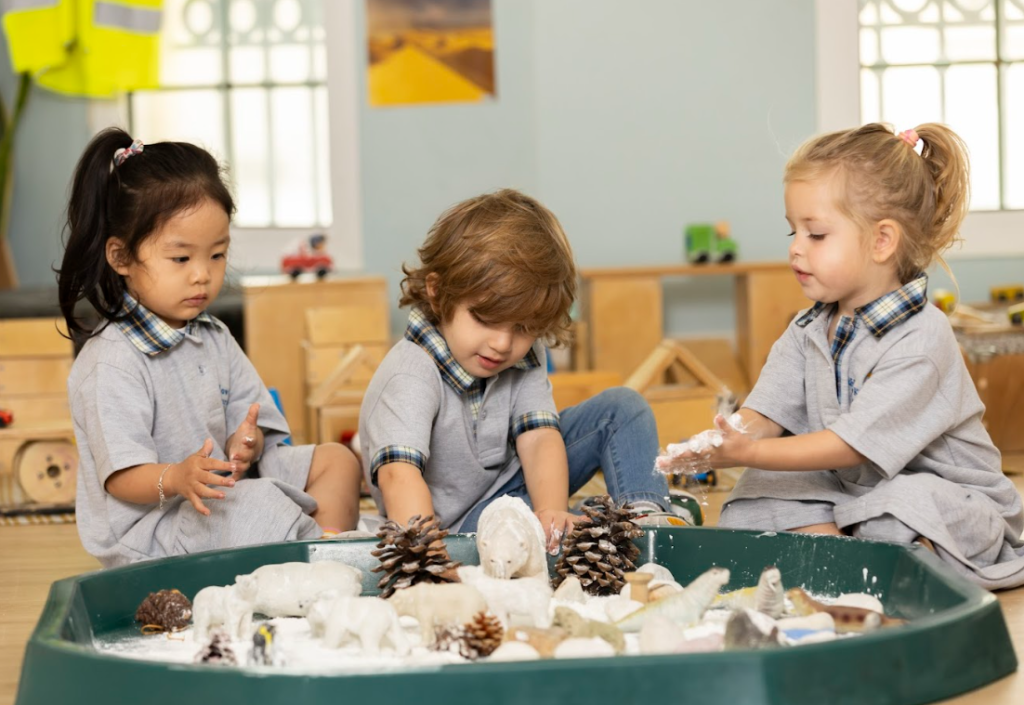
One of the most overlooked aspects of school readiness is physical development. Movement is not a break from learning. It is a driver of it.
In nursery, we talk about squiggle while you wiggle for a reason. When children move their bodies, they are also developing their brains. Crawling, climbing, balancing, dancing, and exploring space all support neural connections that underpin concentration, coordination, and later academic skills.
Pre-writing does not begin with pencils. It begins with strong shoulders, stable cores, flexible wrists, and confident hands. Activities that involve pushing, pulling, squeezing, mark-making, and movement across the body all prepare children for writing long before letter formation is introduced.
When physical development is rushed or restricted, children can appear academically “behind” later, not because they lack ability, but because their bodies were not given time to develop properly.
Literacy Without Pressure
Literacy in the early years should feel accessible, playful, and meaningful. At nursery, children are immersed in language from the very beginning. Phonics are introduced gently and consistently, using recognised programmes such as Read Write Inc and Letters and Sounds, which are also used within school environments.
Phonics run throughout the year, not as a push towards early reading, but as exposure. Children learn to recognise sounds, blend them, and begin to notice patterns in words. Some children will naturally move towards reading and writing earlier. Others will take more time. Both are entirely appropriate.
In the early terms, focus is placed on listening skills, attention, and sound awareness. As children grow, we begin to explore name recognition and early mark-making, moving gradually towards understanding how print works on a page, such as top to bottom and left to right. This is not formal letter writing. It is about understanding the structure of language.
By the time children leave nursery, some may be reading simple books, others may be confidently recognising sounds or words. What matters is not where they are compared to others, but whether they feel capable and confident in their learning.
Numeracy Through Meaningful Play
Early numeracy is not about worksheets or memorising sums. It is about understanding number language, value, quantity, and patterns through everyday experiences.
Children learn about numbers when they count steps, share snacks, build towers, and notice how many plates are on a table. Spontaneous number play builds a deep understanding of maths that cannot be replicated through rote learning.
We use recognised frameworks such as White Rose Maths to guide our approach, aligning with what children will encounter later in school, while keeping learning grounded in play and exploration. Children develop a sense of number because it makes sense to them, not because they are told it should.
This foundation supports later mathematical thinking far more effectively than early formal instruction.
The Skills That Matter Most
If we had to name the most important school readiness skills, they would not be academic. They would include the ability to concentrate for short periods, listen to instructions, cope with change, ask for help, manage emotions, and recover from small challenges. They would include confidence, curiosity, and resilience.
These skills develop over time, through relationships, consistency, and experience. They are shaped by how children feel about themselves as learners.
This is also where routines such as sleep, self-care, and independence play a role. Children who are supported to manage their own needs gradually feel more secure and capable in new environments. This is as true for a child entering kindergarten in Dubai as it is anywhere else in the world.
Why Nursery Experience Matters
Nurseries do not work with children at one point in time. We understand the full picture. We work with children from infancy through to preschool years, and we understand how early experiences shape later development.
Early years educators are uniquely placed in this regard. Many school teachers have not taught babies or toddlers. Nursery teams understand the progression from early attachment through to independence. This gives us a strong foundation for supporting transitions thoughtfully.
We also work within consistent ratios that prioritise relationships and individual attention. Our ratios remain unchanged, with one educator to five children for under threes, and one to eight for over threes. This ensures children continue to receive the support they need as expectations gradually increase.
Supporting, Not Rushing
We want to reassure families that we are not here to push children forward prematurely. We are here to support each child as an individual.
We stand alongside schools, not against them. Our shared goal is confident, capable children who feel ready to learn. That readiness looks different for every child, and it cannot be defined by age alone.
The recent age cut-off changes give families more choice, not more pressure. They invite conversation, reflection, and advocacy. They do not require childhood to be hurried along.
Principal Laura Says:
“Let’s reframe this: children are preparing for a transition, and the skills we focus on will help them in life, not just at school. These skills aren’t something we simply ‘do’ to a child; they require partnership and support, starting with you as the parent.
The most important skill you can model is emotional regulation. Children learn how to identify and manage their emotions by seeing a regulated adult demonstrate it. Being that guiding presence when they experience big emotions teaches them how to respond themselves.
Independence is another key skill. Allow children to try tasks themselves: slowing down routines so they can put on shoes, carry bags, or open lunch boxes builds confidence. Patience is essential in supporting independence.
Boundaries and hearing ‘no’ are also crucial. In schools and nurseries, group settings mean less flexibility around choices. Learning to accept limits at home prepares children for these environments and helps build resilience.”
Holding the Bigger Picture
As this conversation continues across Dubai, it is important to keep the focus where it belongs. On children. On development. On wellbeing.
School readiness is not about producing a child who can perform early. It is about supporting a child who feels safe enough to learn, explore, and grow.
At nursery, we will continue to do what we do best. We will support the whole child. We will honour development. We will partner with families honestly. And we will advocate for early years practices that protect childhood, rather than compress it. For any family thinking ahead to kindergarten in Dubai, that advocacy begins here, in the earliest years.
If you have questions about your child’s readiness, next steps, or how these changes may affect your family, we are always here to talk it through. Not with urgency or fear, but with experience, care, and a deep understanding of early childhood development.
Because readiness is not about being early, it’s about being ready.